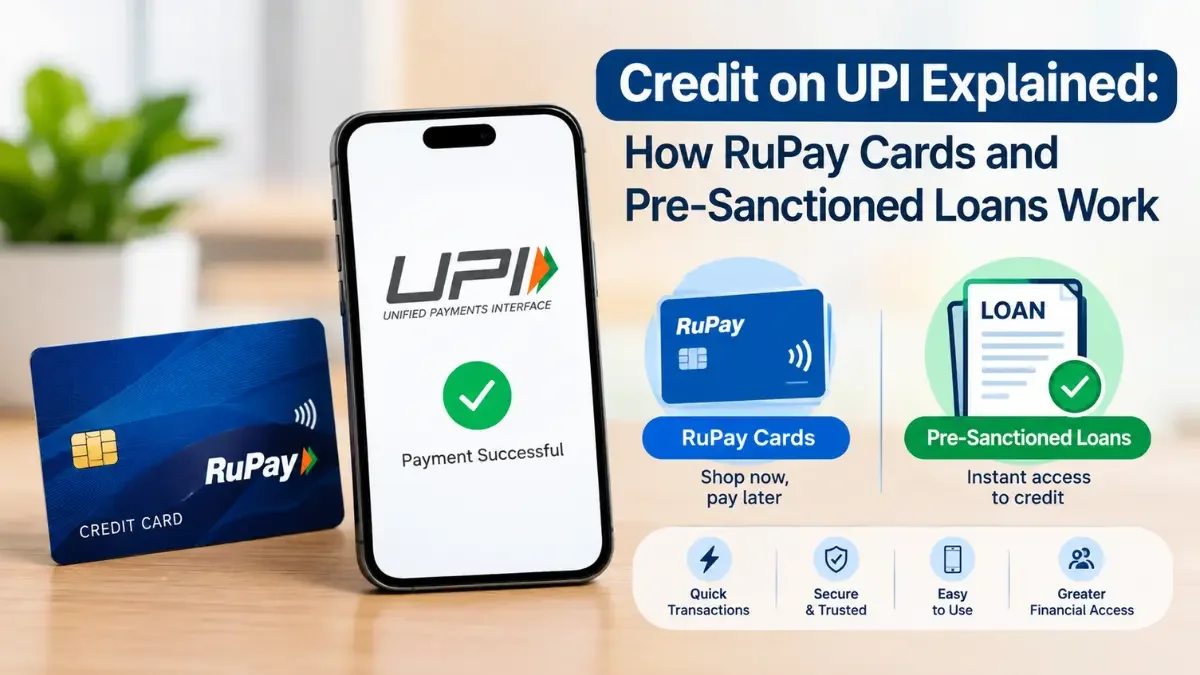
A UPI Credit Line is a pre-sanctioned financial facility approved by banks that enables users to make digital transactions via Unified Payments Interface (UPI) apps using pre-approved credit.
The Evolution of Credit on UPI
For years, UPI functioned strictly as a debit-first payment ecosystem. Every QR scan or peer-to-merchant payment required an immediate draw from a linked savings account or prepaid digital wallet. While this digitized everyday payments across millions of small and large merchants in India, it kept short-term credit tied to traditional financial instruments like plastic credit cards and personal loans.
The Reserve Bank of India (RBI) and National Payments Corporation of India (NPCI) fundamentally reshaped this landscape by enabling credit rails directly over UPI.
Linking RuPay Credit Cards to UPI: RBI permitted credit card transactions over the UPI network, starting with India's indigenous RuPay card network.
Pre-Sanctioned Credit Lines on UPI: RBI expanded the scope beyond credit cards by allowing commercial and small finance banks to offer pre-approved credit lines directly through UPI apps.
This dual framework allows millions of consumers to access short-term credit without needing physical cards or submitting loan applications for small retail purchases.
How RuPay Credit Cards Work on UPI
Prior to RuPay integration, credit cards operated strictly via Point-of-Sale (POS) swipe machines or online payment gateways entering card details, CVVs, and OTPs.
By linking RuPay credit cards to UPI, users can complete credit-backed payments through the familiar UPI workflow.
Setup & Transaction Flow
| Step | Process | Details |
| 1. Link Card | Add Payment Source | Open any supported UPI app (Google Pay, PhonePe, Paytm, BHIM), select "Add RuPay Credit Card," and verify using card details and OTP. |
| 2. Set UPI PIN | Authentication Setup | Create a distinct 4- or 6-digit UPI PIN specifically mapped to the RuPay credit card. |
| 3. Merchant Payment | Scan & Pay | Scan a merchant's UPI QR code, enter the transaction amount, and choose the linked RuPay card as the payment account. |
| 4. PIN Authorization | Instant Settlement | Enter the UPI PIN to authorize the payment instantly, deducting from the card's credit limit. |
Permissible Use Cases & Restrictions
RuPay credit card payments on UPI are designed primarily for Peer-to-Merchant (P2M) transactions.
Supported: Grocery stores, retail outlets, online merchants, utility bill payments, and fuel pumps accepting merchant QR codes or UPI IDs.
Restricted: Peer-to-Peer (P2P) transfers (sending money to friends or family) and transfers to personal bank accounts are strictly prohibited to prevent unauthorized cash advances.
Pre-Sanctioned Loans and Credit Lines on UPI Explained
While linking a RuPay card connects an existing credit card account to UPI, Credit Line on UPI works differently. It operates as a flexible, pre-approved digital overdraft account extended directly by a bank.
Core Mechanics of a UPI Credit Line
Pre-Sanctioned Approval: Banks analyze customer credit scores, account histories, and cash flows to pre-approve a revolving credit limit (e.g., ₹10,000 to ₹1,000,000).
Seamless UPI Linkage: The user enables this pre-sanctioned line within their preferred UPI app without manual paper application or loan disbursal delays.
Pay-as-You-Use Interest: Interest is charged only on the amount utilized, not on the total sanctioned limit.
If a user has a pre-approved limit of ₹50,000 but spends ₹2,000 via UPI, interest accrues solely on ₹2,000. Flexible Repayments: Users can repay spent funds through their UPI app in full or via structured monthly installments (EMIs), resetting their available balance.
RuPay Credit Card vs. UPI Credit Line
Though both options allow credit-based purchases via UPI apps, their structures, target audiences, and regulatory terms differ:
| Feature | RuPay Credit Card on UPI | Pre-Sanctioned Credit Line on UPI |
| Underlying Account | Standard Credit Card Account | Bank-offered Overdraft / Credit Facility |
| Physical Requirement | Physical/Virtual Credit Card Issued | Fully Cardless (Digital Account) |
| Interest Structure | Interest-free period (45–50 days), then finance charges | Interest calculated based on utilization & bank policy |
| Target Segment | Existing Credit Cardholders | Pre-approved Bank Customers & New-to-Credit Borrowers |
| Acceptance | Merchant QR codes (P2M) | Merchant QR codes & designated use cases |
| Regulatory Framework | Credit Card Directions | Prudential Lending & Credit Facility Regulati |
Regulatory Framework and Consumer Safeguards
To prevent over-leveraging and maintain financial stability, the RBI maintains strict regulatory guardrails on payment-linked credit products:
Prudential Standards: Under RBI guidelines, linking a credit facility to a payment instrument like UPI does not alter its regulatory treatment.
Banks must adhere to standard income recognition, asset classification, and provisioning norms. Explicit Customer Consent: Lenders cannot activate pre-sanctioned credit lines or link credit cards without explicit, documented user consent.
Board-Approved Credit Policies: Any payment-linked loan product must be formally incorporated into a bank's board-approved credit policy.
No Shadow Lending: Only regulated entities (scheduled commercial banks, small finance banks, and co-operative banks) can underwrite and offer these credit products.