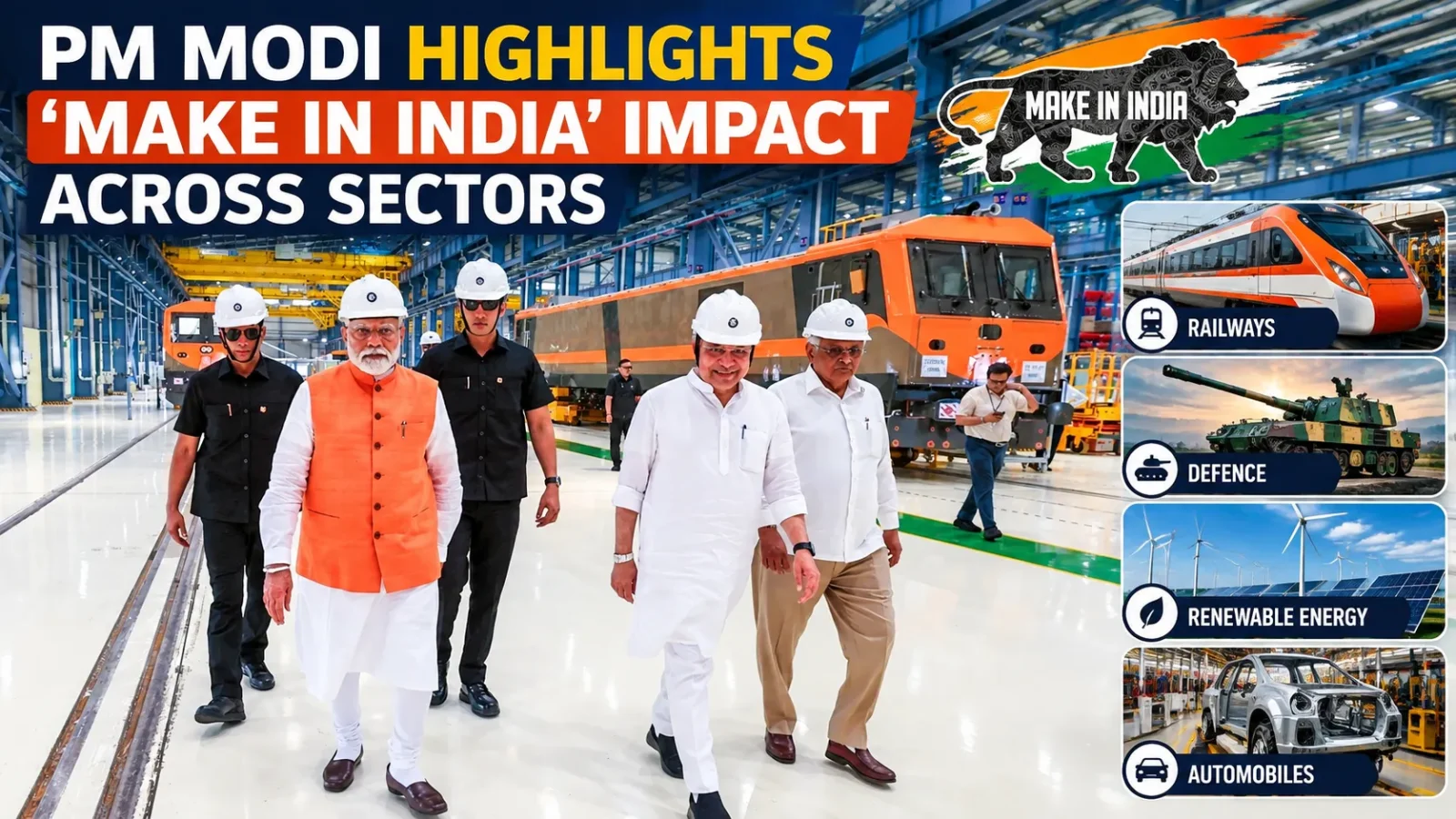
Prime Minister Narendra Modi has highlighted the expansion of domestic manufacturing across electronics, mobile phones, defence, automobiles, pharmaceuticals and railways as the Make in India initiative completes 12 years on September 25, 2026. The programme was launched on the same date in 2014 with the stated objective of developing India as a global manufacturing, design and innovation hub.
Government data released for the anniversary point to large increases in production in several individual industries. At the same time, manufacturing currently contributes about 16–17% of India's GDP, below the earlier government goal of raising the sector's share to 25%, providing important context to the sector-specific gains.
Make in India Completes 12 Years
Make in India was launched by Modi on September 25, 2014, with a focus on attracting investment, encouraging innovation, developing industrial infrastructure and making it easier for companies to manufacture in India.
The initiative has since expanded under Make in India 2.0 and currently covers 27 sectors — 15 manufacturing and 12 services, according to the government's anniversary backgrounder.
Policies introduced or linked with the broader manufacturing push include the Production Linked Incentive schemes, the National Single Window System, PM GatiShakti and industrial-land initiatives.
Modi has also linked Make in India with the government's wider Aatmanirbhar Bharat, or self-reliance, agenda. In his 2026 Independence Day address, he cited growth in defence, electronics and mobile-phone production while arguing for stronger domestic capabilities.
Electronics Production Rises Nearly Sevenfold
Electronics has recorded one of the largest increases highlighted in the latest government data.
India's electronics production rose from approximately ₹1.9 lakh crore in 2014-15 to ₹13.11 lakh crore in 2025-26, an increase of nearly seven times, according to the Press Information Bureau.
Mobile-phone production increased from around ₹18,000 crore to ₹6.27 lakh crore over the same period — roughly a 33-fold increase.
The government says India is now the world's second-largest mobile-phone manufacturer by volume. It has also stated that 99.2% of mobile phones used domestically are manufactured in India.
The Cabinet in July approved a new Mobile Phone Manufacturing Scheme with a ₹62,500-crore outlay for FY2026-27 to FY2030-31, aimed at increasing production and domestic value addition.
Defence Production Reaches ₹1.78 Lakh Crore
Defence manufacturing is another sector highlighted by Modi and the government in discussions around domestic production.
The value of indigenous defence production increased from ₹46,429 crore in 2014-15 to ₹1.78 lakh crore in FY2025-26, according to the latest official figures. That represents an increase of about 283%.
During his Independence Day address, Modi said defence production had risen nearly fourfold over the preceding 12 years and stressed expanding indigenous defence capabilities.
The government has also encouraged private-sector participation and domestic sourcing as part of its defence-indigenisation strategy.
Steel, Automobiles and Railways Also Record Higher Production
Official anniversary data show increases across several traditional manufacturing industries.
India's crude steel production rose from 81.7 million tonnes in 2014-15 to 170 million tonnes in 2025-26. Vehicle production reached 31.03 million units in 2024-25, around 33% higher than in 2014-15.
Railway manufacturing has also expanded. Indian Railways produced 1,674 locomotives and 6,677 LHB coaches during 2025-26, according to the government.
Modi has frequently cited railway coaches, automobiles and defence equipment as examples of products increasingly manufactured domestically and exported abroad.
Pharmaceuticals and Medical Devices Expand
India remains a major pharmaceutical producer, ranking third globally by production volume and 11th by value, according to government data.
The pharmaceutical industry's annual turnover reached ₹4.72 lakh crore in 2024-25, while domestic medical-device manufacturing increased from about ₹28,000 crore in 2019-20 to ₹41,500 crore in 2024-25.
The government's manufacturing strategy has increasingly focused not only on final products but also on components, equipment and higher-value technologies.
Recent policy priorities include semiconductors, rare-earth permanent magnets, specialty steel, solar manufacturing and advanced industrial machinery.
PLI Schemes Attract ₹2.40 Lakh Crore Investment
Production Linked Incentive schemes now cover 14 sectors.
As of June 2026, the government says PLI schemes had attracted ₹2.40 lakh crore in investment, generated more than ₹22.66 lakh crore in production and sales, supported ₹15.20 lakh crore in exports and created more than 14 lakh jobs.
Cumulative foreign direct investment between 2014-15 and 2025-26 stood at $843 billion, according to the same government backgrounder.
These figures cover a wider set of investment and industrial policies and should not necessarily be interpreted as activity caused solely by Make in India.
The Broader Manufacturing Picture
The sector-level numbers show significant expansion, particularly in electronics, mobiles and defence. However, the broader picture is more mixed.
An August 2026 government factsheet puts manufacturing's contribution to India's GDP at approximately 16–17%. An earlier policy goal associated with Make in India sought to increase manufacturing's GDP share from around 16% to 25%.
This means that while output in several industries has grown substantially, increasing manufacturing's overall share of the economy remains an ongoing policy objective.
Recent performance has nevertheless shown momentum: manufacturing GVA at constant prices recorded a 10.88% compound annual growth rate between 2022-23 and 2025-26, while manufacturing IIP rose 7% year-on-year during April-July 2026.
Key Facts
- Make in India was launched on September 25, 2014 and completed 12 years in 2026.
- Electronics production reached about ₹13.11 lakh crore in 2025-26.
- Mobile-phone production reached roughly ₹6.27 lakh crore.
- Indigenous defence production reached ₹1.78 lakh crore in FY2025-26.
- Crude steel production increased to 170 million tonnes in 2025-26.
- Manufacturing currently accounts for roughly 16–17% of GDP.
Why This Matters
Manufacturing is important to India's economic strategy because it affects employment, exports, supply-chain resilience, technology development and investment.
The government's next phase is increasingly focused on deeper domestic value addition rather than simply assembling final products. Semiconductors, electronic components, strategic materials and industrial machinery are therefore becoming more prominent in manufacturing policy.
How successfully India increases domestic value addition, manufacturing employment and the sector's overall share of GDP will be key measures of the initiative's longer-term performance.
FAQs
When was Make in India launched?
Prime Minister Narendra Modi launched Make in India on September 25, 2014, making September 25, 2026 its 12th anniversary.
How much has India's electronics production grown?
Government data show electronics production increased from about ₹1.9 lakh crore in 2014-15 to approximately ₹13.11 lakh crore in 2025-26.
How much is India's defence production?
Indigenous defence production reached a record ₹1.78 lakh crore in FY2025-26, according to the Defence Ministry and PIB.
What percentage of India's GDP comes from manufacturing?
A government factsheet published in August 2026 says manufacturing contributes approximately 16–17% of GDP.
What is the objective of Make in India?
The initiative was created to promote manufacturing, attract investment, foster innovation, improve infrastructure and strengthen India's position in global manufacturing.