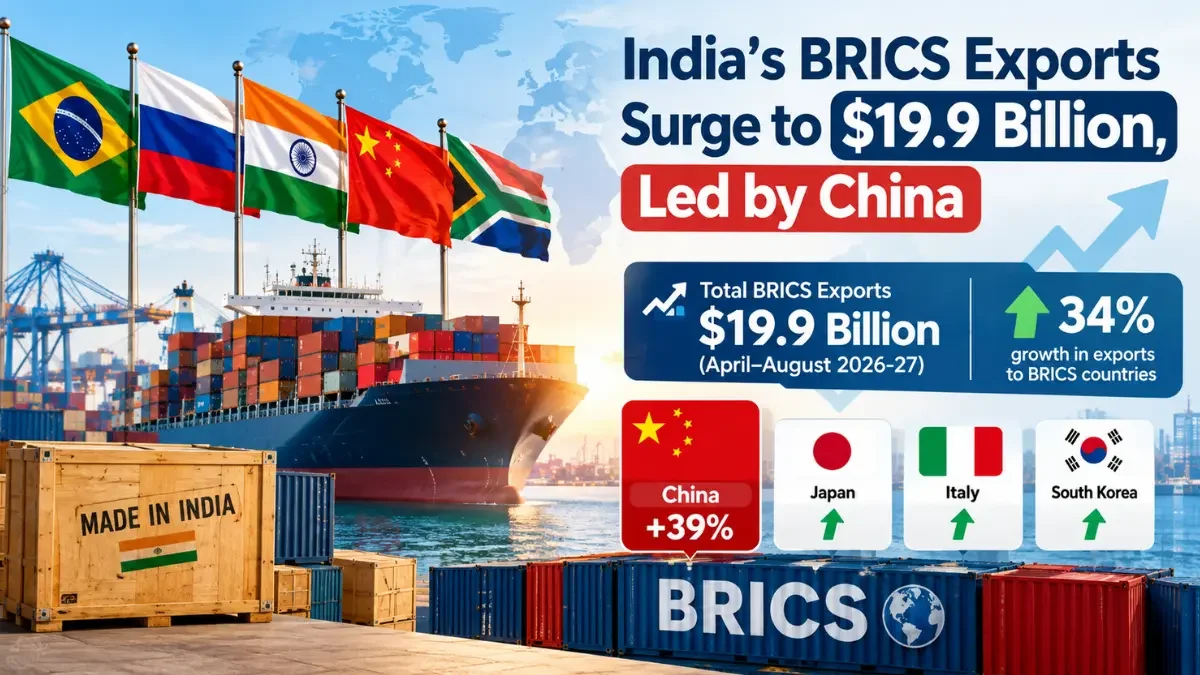
India's exports to core BRICS economies — China, South Africa, Brazil and Russia — grew 34% year-on-year to $19.9 billion in April–August of FY2026-27, with a 39% surge in shipments to China leading the gains.
A Notable Shift in India's Trade Priorities
Fresh data from India's commerce ministry has put a spotlight on the growing weight of the BRICS bloc in the country's export strategy. Exports to China, South Africa, Brazil and Russia climbed sharply over the first five months of the current financial year, rising from $14.9 billion in April–August 2025-26 to $19.9 billion in the same period this year — a jump of 34%. The figures reflect not just a single strong month but a sustained five-month trend, suggesting the growth is structural rather than a short-term blip.
An official quoted in the data release framed the shift as part of a deliberate deepening of ties with the bloc. As India deepens its engagement with BRICS, the strongest momentum is coming from the core founding partners — China, South Africa, Brazil and Russia — even as the broader BRICS grouping has expanded substantially in recent years.
China Leads the Charge
Among the four core countries, China stands out as both the largest and fastest-growing major destination by absolute value. Indian exports to China expanded by 39% to reach $9.6 billion in the first five months of 2026-27, making it the single biggest contributor to the overall BRICS export surge. Given that China alone accounts for roughly half of the $19.9 billion total, its performance is effectively driving the headline number for the entire core bloc.
This is a striking figure given the historically uneven and often tense trade relationship between the two countries. India has long run a substantial trade deficit with China, with imports from the northern neighbor dwarfing exports in most previous fiscal years. A 39% jump in exports to China, even against that backdrop, signals meaningful new demand for Indian goods in the Chinese market, or at least a rebound from a previously suppressed base.
South Africa Posts the Fastest Growth Rate
While China led in dollar terms, South Africa actually posted the fastest percentage growth among the four core BRICS nations. Exports to South Africa surged 58% during the period, the steepest increase of any core BRICS destination. Brazil and Russia, meanwhile, posted more modest but still healthy double-digit growth, expanding by 13% and 11% respectively.
The pattern — one very large market (China) growing fast in absolute terms, one smaller market (South Africa) growing even faster in percentage terms, and two others (Brazil and Russia) posting steady, moderate gains — paints a picture of broad-based momentum across the bloc rather than growth concentrated in a single relationship.
Outpacing the Broader BRICS Grouping
One of the more telling aspects of this data is how much faster the core four are growing compared to the expanded BRICS bloc as a whole. BRICS, which originally comprised just Brazil, Russia, India, China and South Africa, expanded significantly in 2024 to include Egypt, Ethiopia, Iran, the United Arab Emirates and Saudi Arabia, with Indonesia joining the bloc in 2025. A further set of countries — Belarus, Bolivia, Kazakhstan, Cuba, Malaysia, Nigeria, Thailand, Uganda, Uzbekistan and Vietnam — became BRICS partner countries last year, making the grouping considerably larger and more diverse than it was even a few years ago.
Despite this expansion, it's the founding four — excluding India itself — that are outperforming the group average by a wide margin. With exports to core BRICS growing nearly three times faster than exports to the broader BRICS grouping, these markets are increasingly emerging as a key pillar of India's export strategy, according to the commerce ministry official cited in the data. That framing suggests Indian policymakers see targeted engagement with the founding BRICS economies — rather than the newer, more diffuse membership — as the more productive near-term opportunity for export growth.
A Rising Share of India's Overall Export Basket
The growth in absolute export value has also translated into a meaningfully larger share of India's total export basket. The proportion of India's total exports accounted for by the four core BRICS countries rose from 8.1% in the first five months of last fiscal year to 9.2% in the same period this year. While a roughly one-percentage-point shift might sound modest, on India's total export base — which touched an all-time high of $824.9 billion for the full 2024-25 fiscal year — even small percentage-point movements represent billions of dollars in reallocated trade flows.
This upward trajectory in BRICS's share of Indian exports comes at a time when India has also been actively courting other major markets. The same data set that tracked BRICS performance also highlighted strong growth to several non-BRICS partners. Exports to Japan increased by 43%, reaching $3.43 billion, supported by higher shipments of mineral fuels, electronics and aluminium. Italy recorded a 30% rise to $3.92 billion, while shipments to South Korea grew by 22% to $3.21 billion. Taken together, this suggests India's export growth story over the past five months has been broad-based, spanning both traditional Western-aligned partners and the BRICS bloc simultaneously — rather than reflecting a wholesale pivot away from one group of trading partners toward another.
What's Driving the Growth
The categories underpinning this export surge offer a clue to where India's manufacturing and industrial base is finding the most traction internationally. Industrial raw materials, intermediate goods, chemicals, and iron and steel have been cited as key drivers of the broader export increase to major partner countries during this period. These are precisely the kinds of goods where India has been investing in manufacturing capacity and where global supply chains have been actively diversifying away from single-source dependency in recent years — a dynamic that has generally worked in India's favor as multinational buyers look to add alternative suppliers.
Why This Matters for Indian Industry
For companies operating in manufacturing, commodity processing, engineering and logistics, these export trends carry direct commercial relevance. Firms that rely on overseas demand to sustain revenue growth and order books stand to benefit most directly from a sustained uptick in shipments to China, South Africa, Brazil and Russia. Export-oriented sectors in particular may see this data as a signal to deepen their engagement with BRICS markets, especially given that the growth appears consistent across a five-month window rather than being the product of a single large one-off shipment or contract.
At the same time, trade watchers will likely want to see whether this momentum sustains itself through the remainder of the fiscal year, particularly given the volatility that has periodically affected India's trade relationships with individual BRICS members — from geopolitical tensions with China to sanctions-related complexities surrounding Russia. A single five-month data point, however encouraging, is not necessarily indicative of a permanent structural shift, and analysts will be watching the next several reporting periods to see if the 34% growth rate holds, accelerates or moderates.
The Bigger Picture: India's Evolving Trade Map
Ultimately, this data offers a window into how India's trade relationships are evolving amid a shifting global economic landscape. As traditional export destinations like the United States face their own set of trade policy uncertainties — including tariff actions that have affected Indian exporters in past cycles — India appears to be actively diversifying its export base, simultaneously strengthening ties with core BRICS partners while also expanding market share in countries like Japan, Italy and South Korea.
The commerce ministry's framing of BRICS as "a key pillar" of India's export strategy suggests this is not accidental but a deliberate policy emphasis, one that aligns with India's broader diplomatic posture of maintaining strategic autonomy while deepening economic ties across multiple blocs simultaneously. Whether this dual-track approach — courting both BRICS and Western-aligned markets — proves sustainable over the long term will be one of the more interesting threads to watch in India's trade policy over the coming fiscal year.
For now, the numbers speak for themselves: a 34% jump in exports to the BRICS core, led by a resurgent trade relationship with China, marks one of the more significant shifts in India's export composition in recent years — one that exporters, policymakers and industry watchers alike will be tracking closely as the fiscal year progresses.