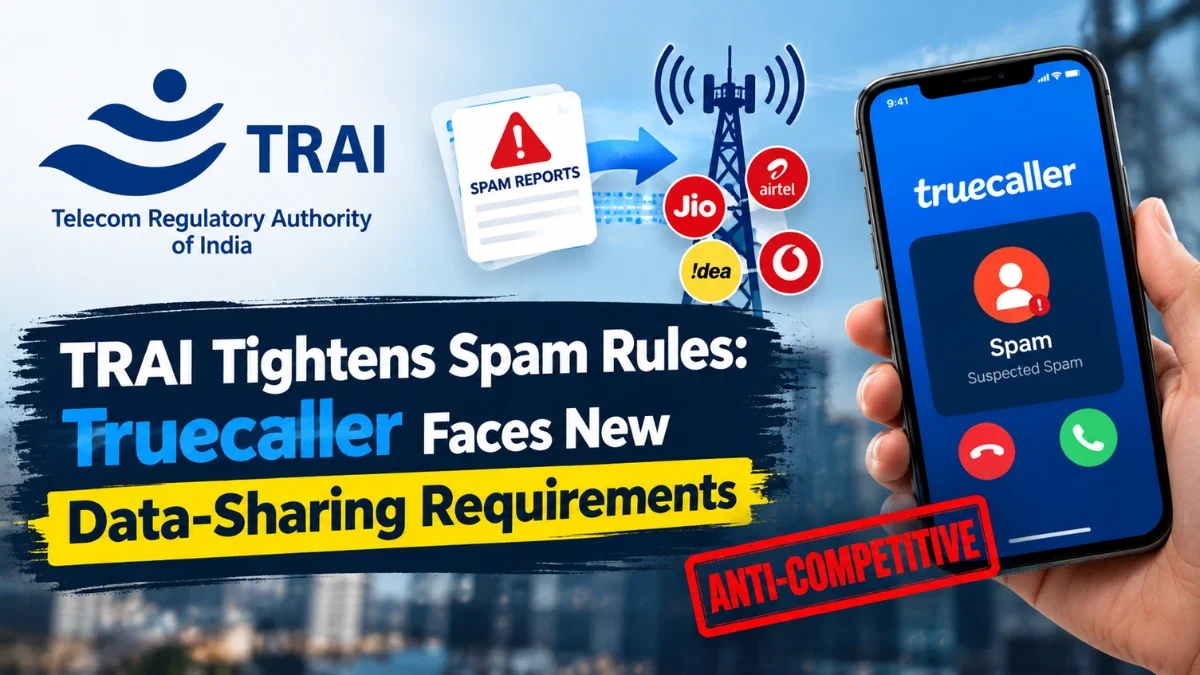
The Telecom Regulatory Authority of India (TRAI) has mandated caller-identification and call-management applications, including Truecaller, to share user-submitted spam reports directly with licensed telecom service providers via a centralized Distributed Ledger Technology (DLT) platform.
The Regulatory Overhaul: Integrating Crowdsourced Data into Telecom Networks
The Telecom Regulatory Authority of India (TRAI) issued major amendments to its Telecom Commercial Communications Customer Preference Regulations (TCCCPR) framework.
Historically, spam reporting in India operated within two parallel, isolated silos:
Third-Party App Silo: Users flagged unwanted telemarketing calls or scam attempts within apps like Truecaller. While this instantly alerted other app users, the underlying phone numbers remained fully active on the telecom carrier's cellular network, continuing to dial users who did not have the app installed.
Official Telecom Silo: Users filed formal complaints through the Do Not Disturb (DND) registry or provider portals. Action was taken against telecom resources only through these official channels, but adoption remained comparatively low due to the multi-step reporting process.
By forcing call-management applications to stream their spam complaint data into the telcos' blockchain-backed DLT network, TRAI aims to bridge this gap.
Key Provisions of TRAI's Anti-Spam Framework
The updated guidelines extend far beyond basic data sharing, establishing stricter technical parameters for identifying, regulating, and penalizing unsolicited commercial communications (UCC).
1. Lower Complaint Thresholds & AI Cross-Referencing
Under the revised framework, the threshold for taking punitive action against a suspect number has been significantly tightened.
If five or more numbers tied to a single entity or individual are flagged within 10 days, the telecom provider must initiate mandatory KYC re-verification and physical address checks.
2. Crackdown on AI Robocalls and Automated Voice Systems
To combat the rise of synthetic voice bots and automated dialers, TRAI has officially reclassified all software-initiated and AI-generated calls as Application-to-Person (A2P) communications.
Mandatory Pre-Declaration: Businesses using automated systems, pre-recorded audio, or AI conversational voice bots must explicitly register these service numbers with their respective carriers.
Financial Penalties: Any undeclared automated or AI-generated commercial call will be automatically classified as spam and incur a mandatory termination penalty of up to 5 paise per minute.
3. Exemption Shield for Designated Number Series
The amendment reiterates restrictions regarding designated operational number series.
140xx Series: Reserved exclusively for regulated telemarketing and promotional calls.
1600xx / 1601xx Series: Reserved for critical transactional and service-related communications (such as banking alerts, OTP verification calls, and government notifications).
Truecaller's Response: Pushback and Anti-Competitive Concerns
The mandate has drawn strong pushback from Truecaller.
In an official statement addressing the amendment, Truecaller highlighted that forcing software developers to surrender their crowd-sourced database to network operators effectively transfers a commercially valuable, proprietary asset to telecom companies without compensation or reciprocal access.
Truecaller also voiced frustration over the ongoing immunity granted to 140xx and 1600xx series numbers.
Industry Comparison: Third-Party Apps vs. Network DLT Integration
| Feature / Metric | Legacy Caller-ID Apps (Pre-Rule) | Revised TRAI Framework (Integrated DLT) |
| Data Repository | Siloed inside app databases | Shared across all licensed telco DLT networks |
| Impact of a Spam Flag | Warns other app users only | Initiates carrier KYC verification & SIM blocks |
| Action Threshold | Varies by app algorithm | 3 unique complaints within 10 days triggers action |
| AI/Robocall Handling | Tagged based on community votes | Classified as A2P with 5p/min penalty if undeclared |
| Consumer Redressal | None (in-app unblocking only) | Formal 15-day regulatory appeal mechanism |
| 140 / 1600 Series Rules | Frequently tagged/blocked by users | Exempt from blanket auto-blocking by third-party apps |
Implementation Challenges & What Lies Ahead
While TRAI’s unified framework represents an aggressive step toward eliminating unwanted communications, legal and technical experts highlight several operational hurdles that must be addressed during execution:
1. Jurisdictional Scope & Regulatory Boundaries
Legal scholars note an ongoing jurisdictional debate regarding TRAI's authority over independent app developers.
2. User Privacy and Consent Frameworks
The rule requires call-management apps to transmit user-generated flags to telecom networks, raising critical privacy questions.
3. Formal Consumer Redressal Mechanisms
To protect legitimate businesses and individuals from malicious flagging, TRAI has introduced a formal Consumer Appeal Mechanism.
Ultimately, TRAI’s mandate marks a definitive shift in India's anti-spam strategy.